The Sahara's Hidden Ocean
Millions of years ago, the world's largest hot desert was a vast tropical ocean teeming with life. Today, a colossal underground reservoir still hides beneath the dunes.
The Tethys Sea: An Ocean Lost in Time
Before the first grain of sand, the Sahara was submerged beneath a warm tropical ocean that shaped the planet.
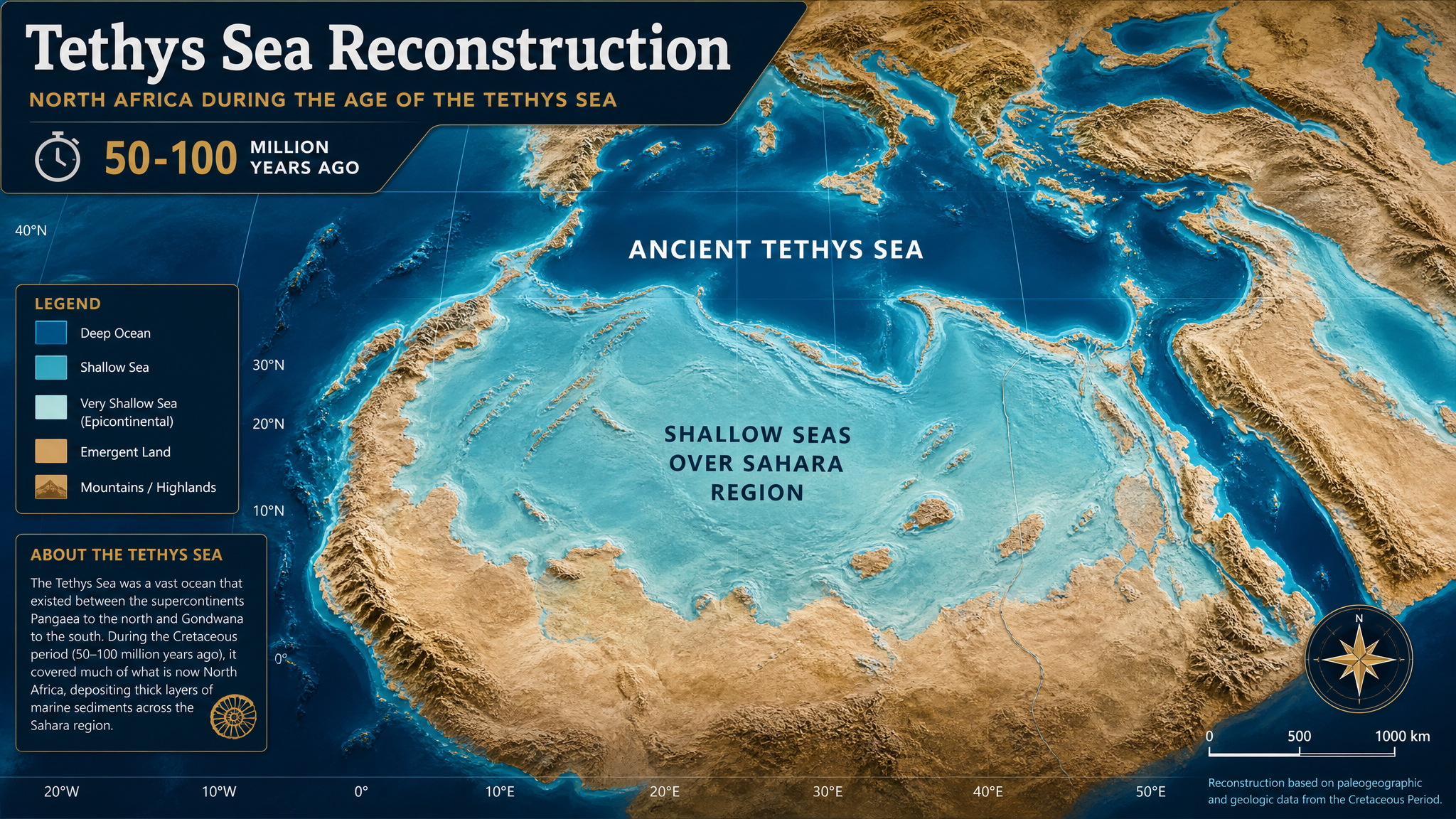
Reconstruction of the Tethys Sea between the ancient supercontinents
Mesozoic Era
252–66 Million Years AgoThe Tethys Sea, a vast tropical ocean, separated the supercontinents of Laurasia and Gondwana. Much of what is now North Africa was submerged beneath warm, shallow waters teeming with marine life.
Tectonic Collision
50–30 Million Years AgoThe African and Indian tectonic plates began colliding with Eurasia, gradually squeezing the Tethys Sea shut. This colossal geological force gave rise to the Alps and Himalayas.
Birth of the Desert
7–11 Million Years AgoThe final shrinkage of the Tethys cut off vital moisture to North Africa. Climate simulations show this triggered intense aridification, transforming a green landscape into the Sahara Desert.
Echoes of the Ocean
The Tethys Sea left behind spectacular evidence locked in the geological layers — from whale skeletons to ancient marine reptiles.

Wadi Al-Hitan: The Valley of Whales
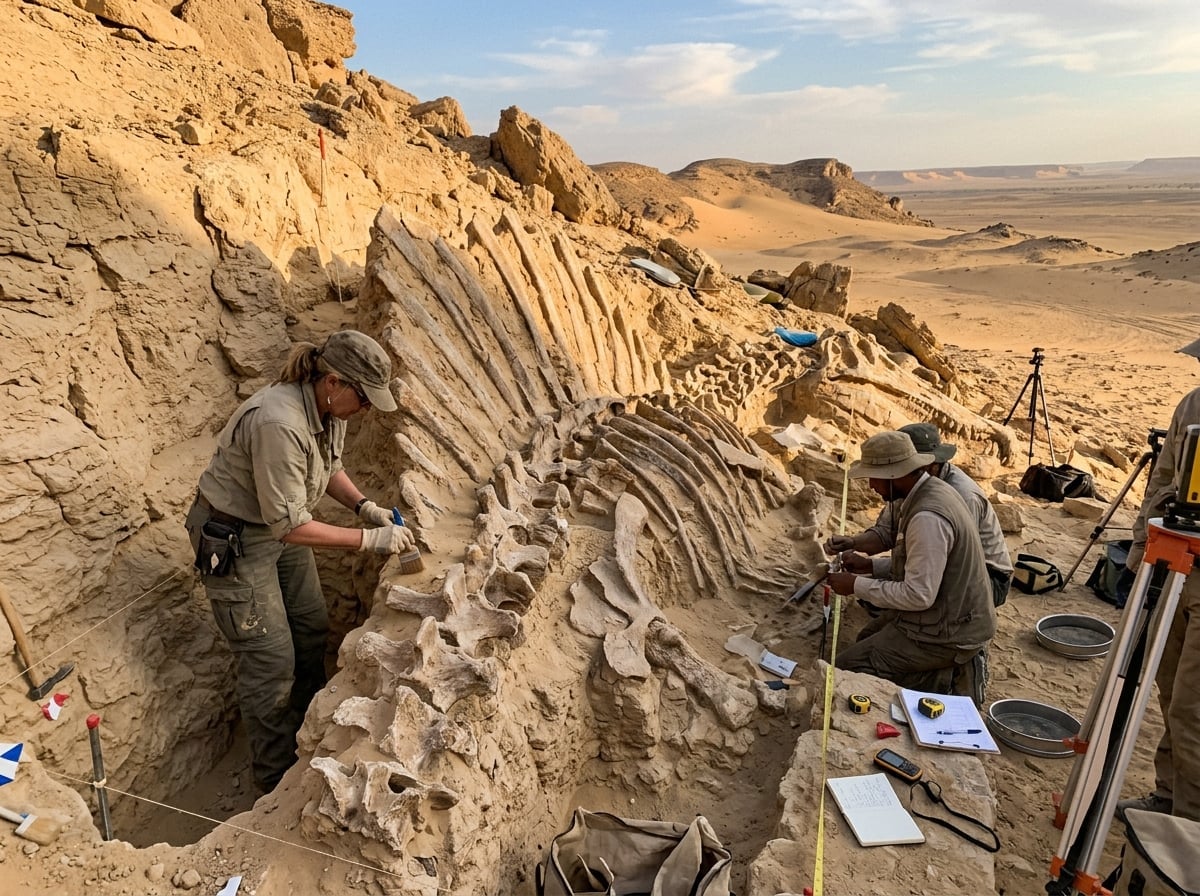
This UNESCO World Heritage site in Egypt is an open-air museum showcasing a crucial moment in evolutionary history — the transition of whales from land-dwelling mammals to ocean giants.
The site contains hundreds of impeccably preserved Archaeoceti skeletons. The most famous specimens include Basilosaurus, an 18-meter predator, and Dorudon, its smaller relative. Some fossils are so well-preserved that their stomach contents remain.

Fossilized skeleton of an ancient whale at Wadi El-Hitan, Egypt
Basilosaurus
An 18-meter serpentine apex predator whose skeleton preserves tiny hind legs with feet and toes — proof that whales evolved from land-dwelling mammals.
Mosasaurs & Plesiosaurs
Massive marine reptiles that dominated the Cretaceous seas. Some plesiosaurs in the Kem Kem river system of Morocco adapted to live in freshwater.
Giant Sea Snakes
Fossils of enormous sea snakes up to 12 meters long, along with giant catfish, sharks, and crocodiles from the Trans-Saharan Seaway.
The Hidden Reservoir Beneath the Sands
The Nubian Sandstone Aquifer System is the largest known fossil water aquifer on Earth — ancient rainwater stored deep underground for millions of years.
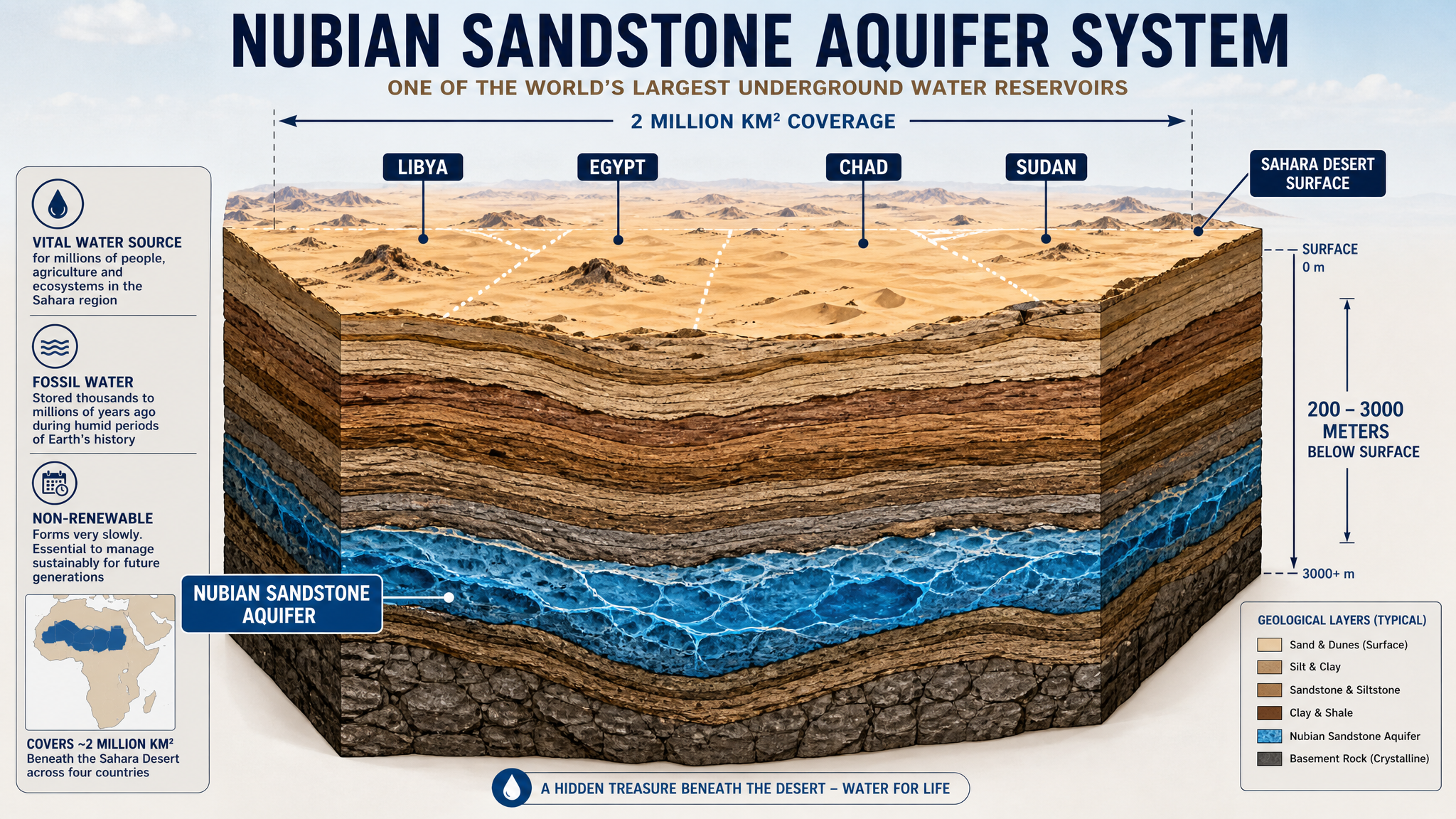
Cross-section of the Nubian Sandstone Aquifer System beneath the Sahara
Aquifer Quick Facts
Tapping the Ancient Waters
Ambitious engineering projects are attempting to bring the Sahara's hidden water to the surface — but at what cost?
Libya's Great Man-Made River
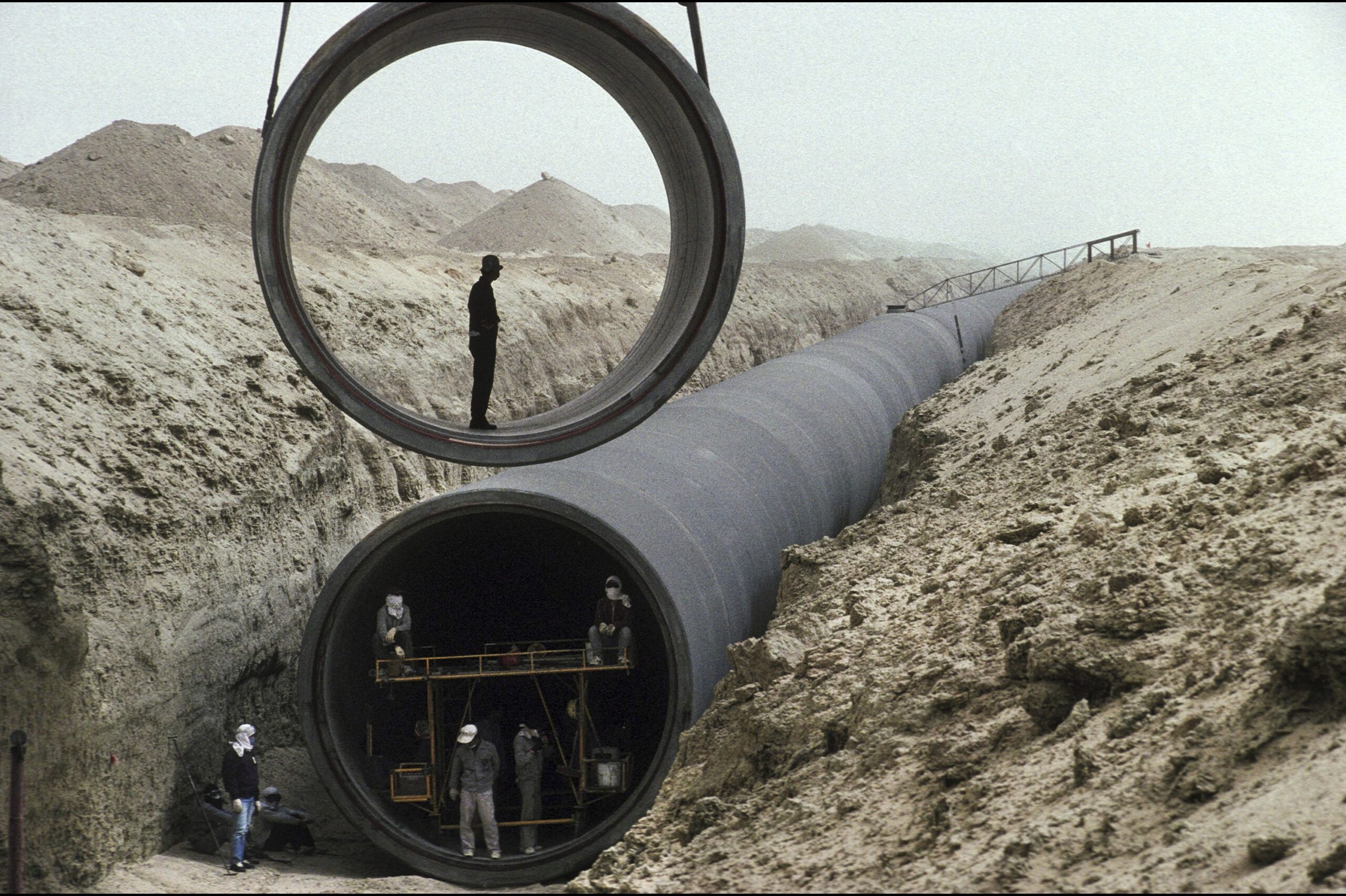
The Great Man-Made River is one of the largest civil engineering projects ever undertaken. This colossal network of underground pipes, stretching thousands of kilometers, pumps fossil water from deep wells in the southern Sahara to coastal cities.
The system supplies water for agriculture and domestic use, transforming arid landscapes into productive farmland. In Egypt, similar projects support land reclamation and new agricultural settlements in the Western Desert.
The Sustainability Challenge
Non-Renewable Resource
The NSAS holds "fossil water" that accumulated over thousands to millions of years. Once extracted, it cannot be replaced on any human timescale.
Over-Extraction Risks
Heavy pumping can lead to aquifer depletion, land subsidence, and saltwater intrusion in coastal areas, threatening long-term water security.
Cross-Border Cooperation
The aquifer spans four nations, requiring coordinated management agreements to prevent competitive over-extraction and ensure equitable access.
Where to Drill
Identifying the optimal drilling locations across four nations to unlock the Sahara's vast underground water reserves.
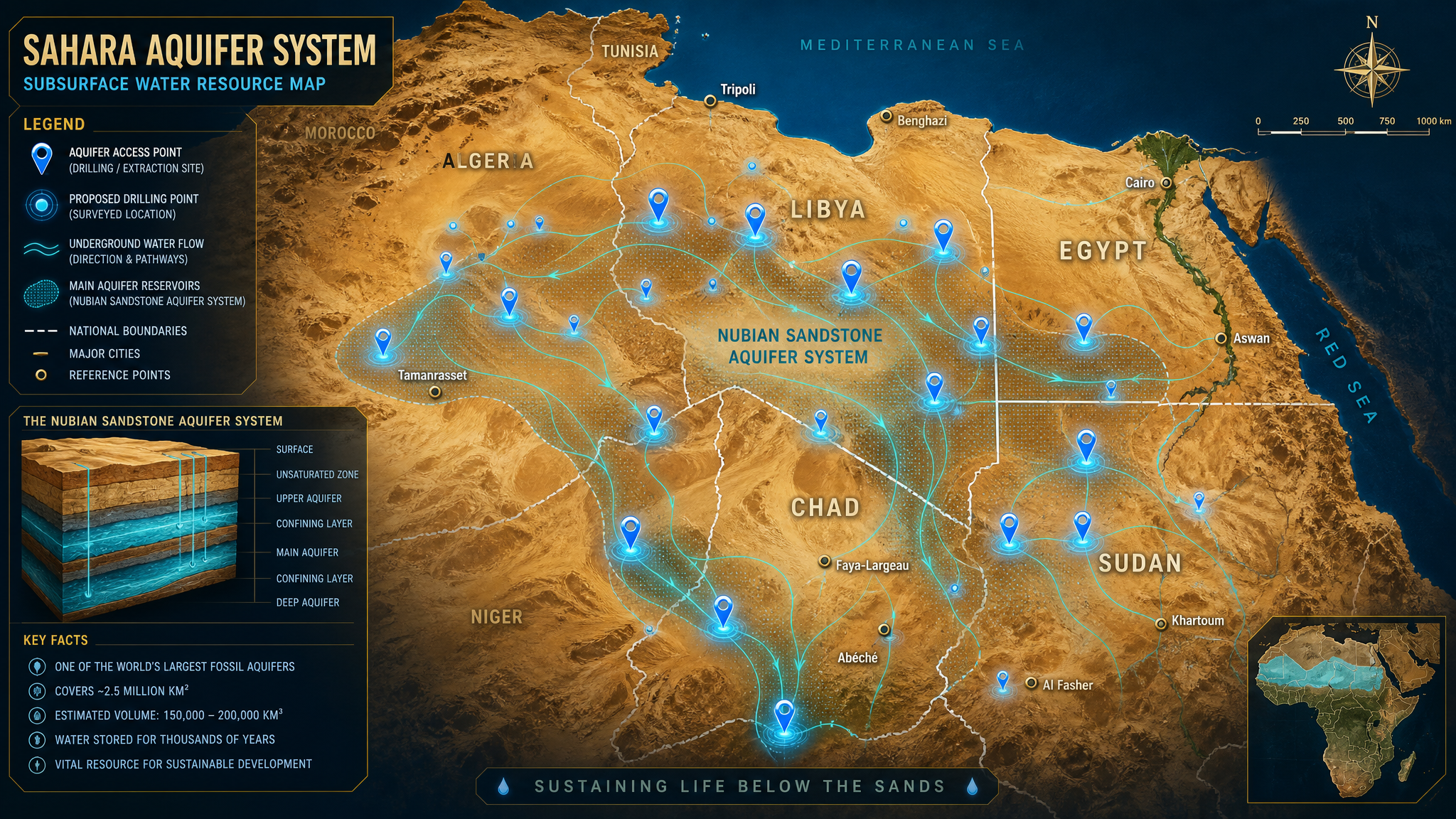
Strategic drilling zones across the Nubian Sandstone Aquifer System — spanning 2 million km²
Libya
1,300+ wellsKufra & Sarir Basins
Home to the Great Man-Made River wellfields. Over 1,300 wells already operational, tapping into the deepest and most productive zones of the NSAS.
Egypt
800+ wellsEast Oweinat & Toshka
Major land reclamation zones in the Western Desert. Center-pivot irrigation systems mine fossil water for wheat and potato cultivation at industrial scale.
Sudan
200+ wellsNorthern Darfur & Nile Basin
Untapped potential for localized water supply. Hydrogeological surveys indicate substantial reserves suitable for community-scale extraction.
Chad
100+ wellsBorkou-Ennedi-Tibesti
The aquifer's southwestern edge. Strategic shallow drilling could provide vital water access for pastoral communities and emerging agricultural projects.
The Drilling Process
Phase 1
Hydrogeological Survey
Satellite mapping, seismic analysis, and test boreholes to identify optimal extraction points and assess aquifer thickness.
Phase 2
Exploratory Drilling
Deep boreholes (100–800m) drilled to confirm water quality, flow rates, and sustainable yield capacity at each strategic point.
Phase 3
Production Well Installation
Industrial-grade submersible pumps installed with monitoring systems. Wells spaced 1.3 km apart to minimize drawdown interference.
Phase 4
Pipeline Connection
Wells connected to the main conveyance network via feeder pipelines, with booster stations positioned at calculated intervals.
Pipelines & Pumps
The engineering marvels that move water across the world's largest desert — from deep underground to the surface and beyond.
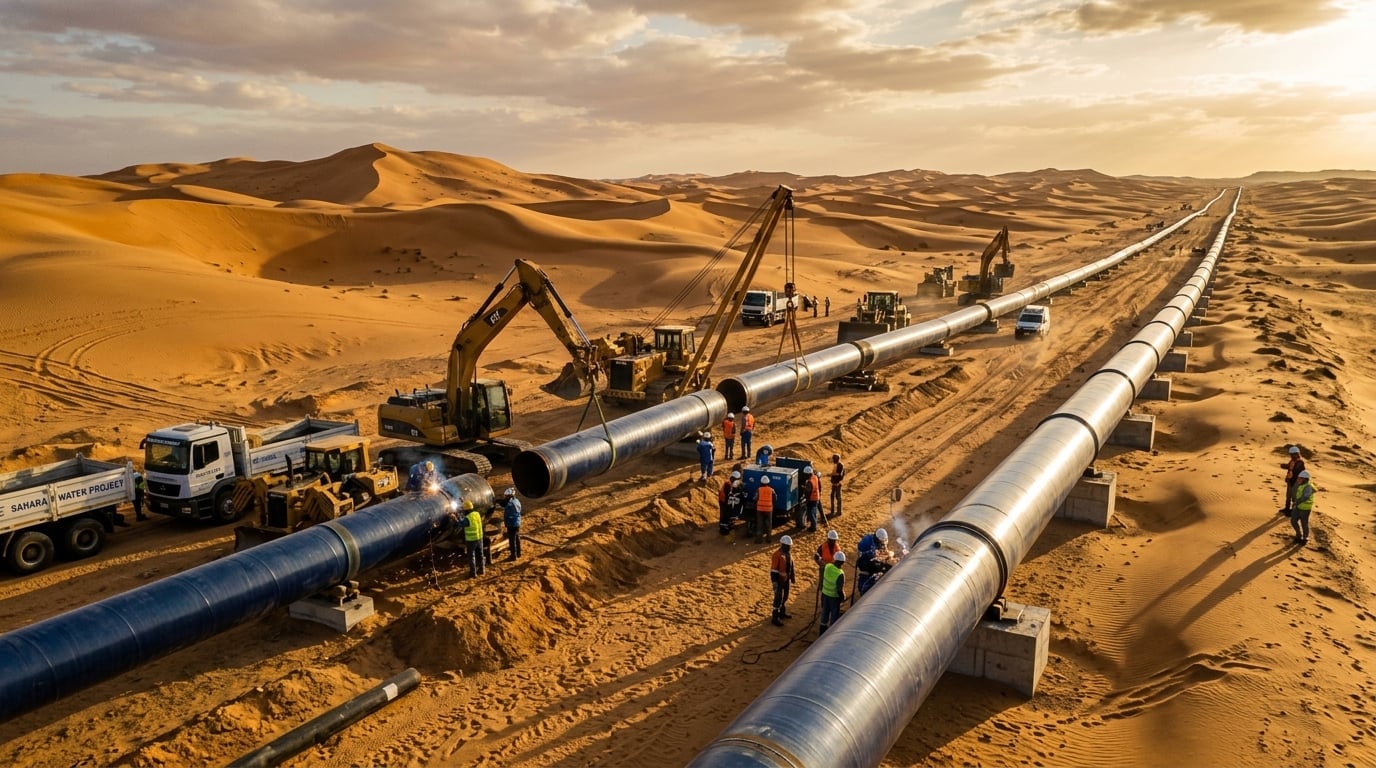
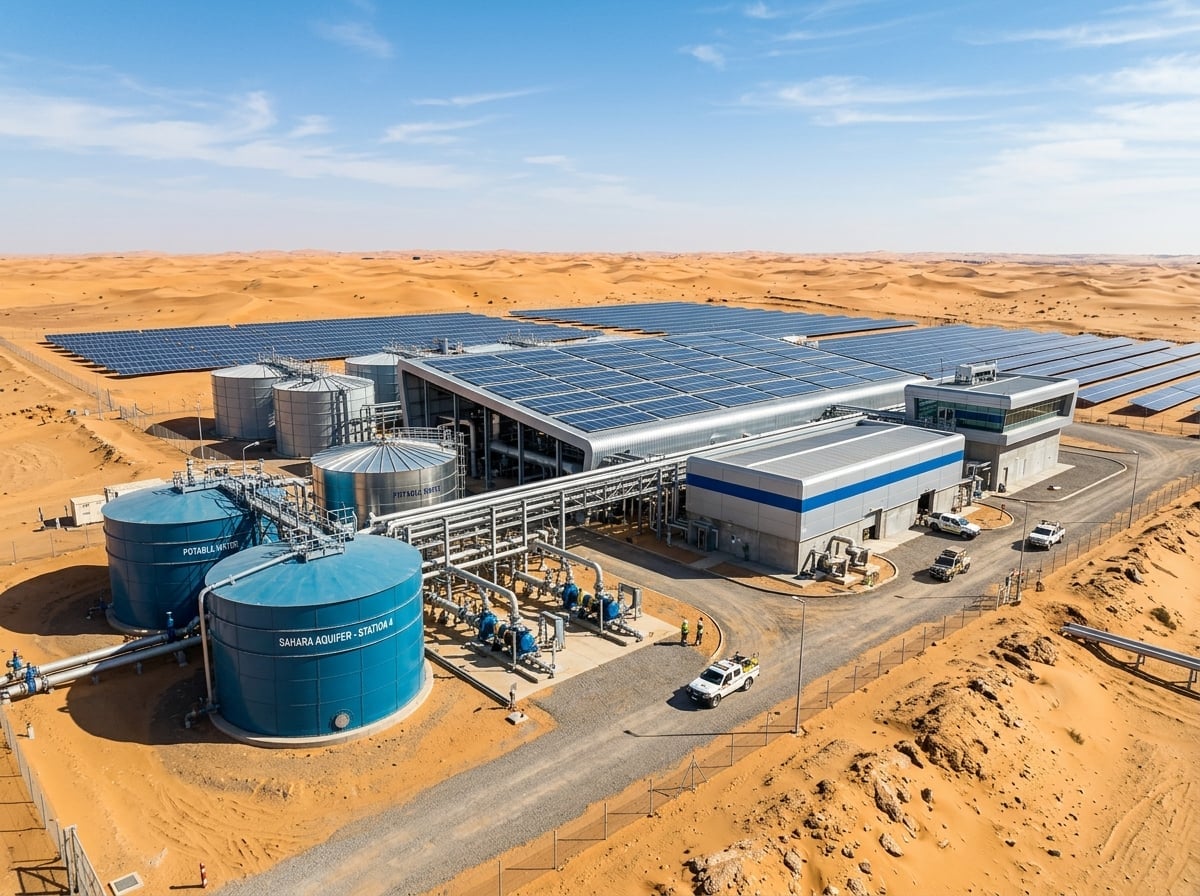
Pipeline Specifications
Pipe Diameter
4 meters
Pre-stressed concrete cylinder pipes (PCCP), each 7.5m long and weighing 73–80 tons
Total Network
4,000+ km
Underground pipeline spanning from southern wellfields to northern coastal cities
Daily Capacity
6.5M m³/day
Equivalent to 1.7 billion gallons of fresh water pumped daily across the desert
Well Depth
500–800m
Submersible electric pumps reach deep into the Nubian Sandstone Aquifer
Pumping Technology
Submersible Well Pumps
Electric submersible pumps installed at 500–800m depth in production wells. Designed for continuous operation in extreme conditions, lifting water to the surface from the aquifer.
Booster Station Pumps
High-performance double-suction multistage (HPDM) pumps at strategic intervals. These axially-split units maintain hydraulic pressure across thousands of kilometers.
Solar-Powered Pumps
Next-generation photovoltaic-driven pumping systems for remote and smaller-scale extraction points. Sustainable and low-maintenance for rural water supply.
Major Pipeline Projects
| Project | Country | Length | Status |
|---|---|---|---|
| Great Man-Made River | Libya | 4,000 km | Operational |
| Tamanrasset Supply Line | Algeria | 1,062 km | Operational |
| Trans Africa Pipeline (TAP) | Pan-African | 8,800 km | Proposed |
| Toshka Land Reclamation | Egypt | 310 km | Active |
Growing Life in the Desert
From ancient oasis farming to cutting-edge greenhouses — the Sahara's underground water can transform barren sand into bountiful harvests.
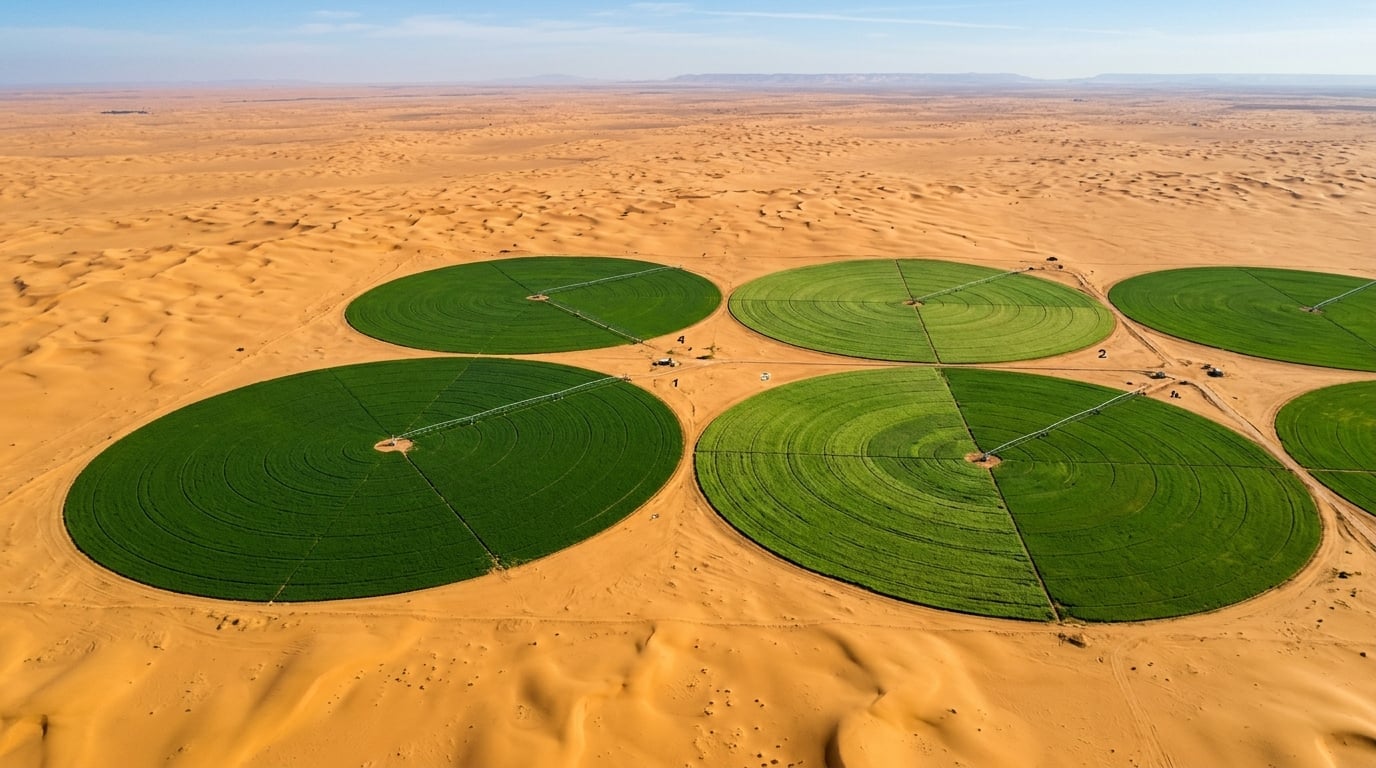
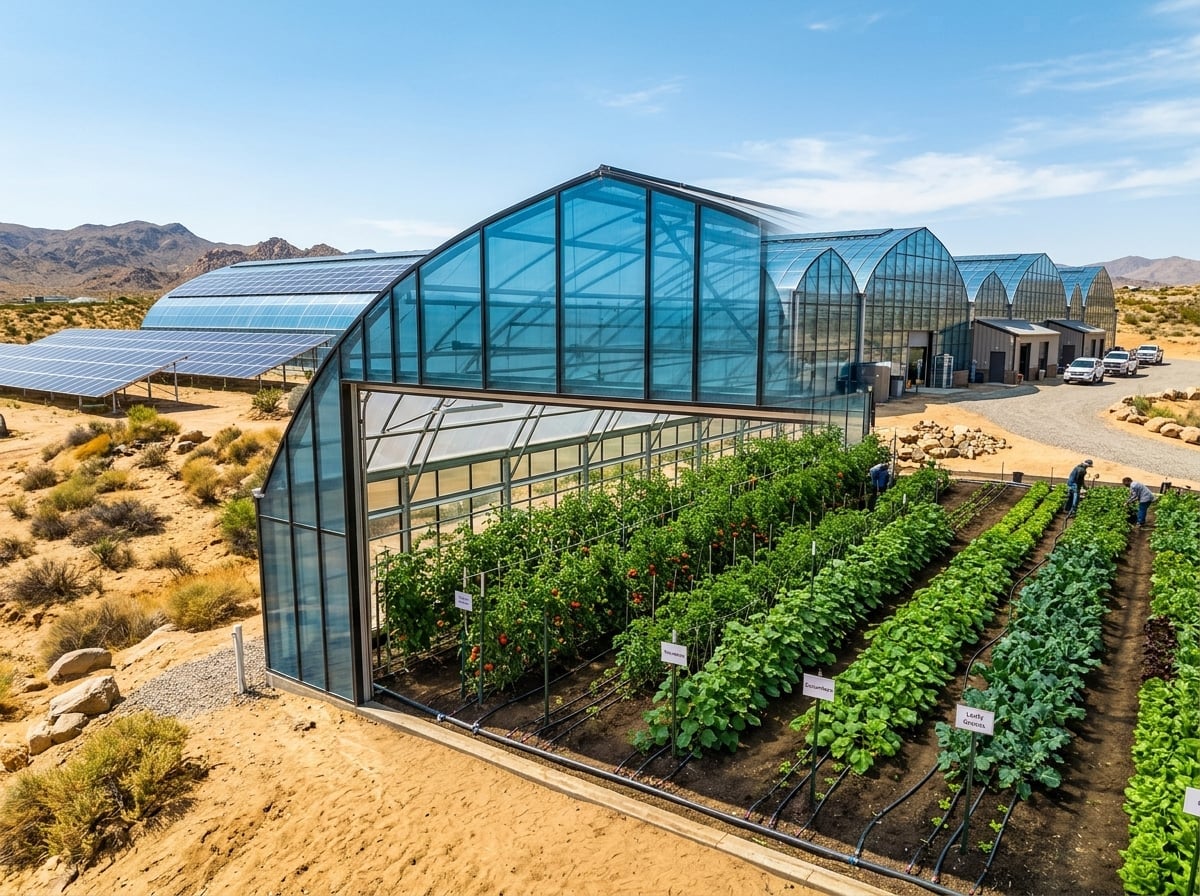
Irrigation Methods
Drip Irrigation
90–95% efficientDelivers water directly to plant roots through a network of tubes and emitters. The gold standard for desert farming, minimizing evaporation losses.
Center Pivot
75–85% efficientLarge rotating sprinkler systems creating the iconic green circles visible from satellite imagery. Used for wheat, potatoes, and fodder crops.
Greenhouse Hydroponics
95–99% efficientSoilless cultivation in controlled environments using nutrient-rich water solutions. Maximum yield with minimum water consumption.
Vegetables & Staple Crops
These crops are already being successfully cultivated across the Sahara using underground aquifer water.
Tomatoes
One of the most successful desert greenhouse crops. Thrives with drip irrigation and produces high yields in controlled environments.
Cucumbers
Rapid growth cycle makes them ideal for desert farming. Greenhouse cultivation protects from extreme heat and sandstorms.
Bell Peppers
Colorful and nutritious, peppers adapt well to warm climates with efficient water use through localized drip systems.
Onions
Drought-tolerant and hardy. A staple crop for desert agriculture across North Africa, requiring minimal water input.
Potatoes
Successfully cultivated in Egypt's Western Desert using center-pivot irrigation. A key crop for food security programs.
Carrots
Root vegetables that thrive in sandy desert soils. The natural soil composition of the Sahara is surprisingly suitable.
Leafy Greens
Lettuce, spinach, and herbs grown under shade structures or greenhouse environments. Fast harvest cycles ensure consistent supply.
Wheat
A strategic staple crop grown via center-pivot irrigation at Egypt's East Oweinat. Vital for regional food independence.
Desert Fruits
Heat-tolerant fruit trees and vines that thrive in the Saharan climate when water is available.
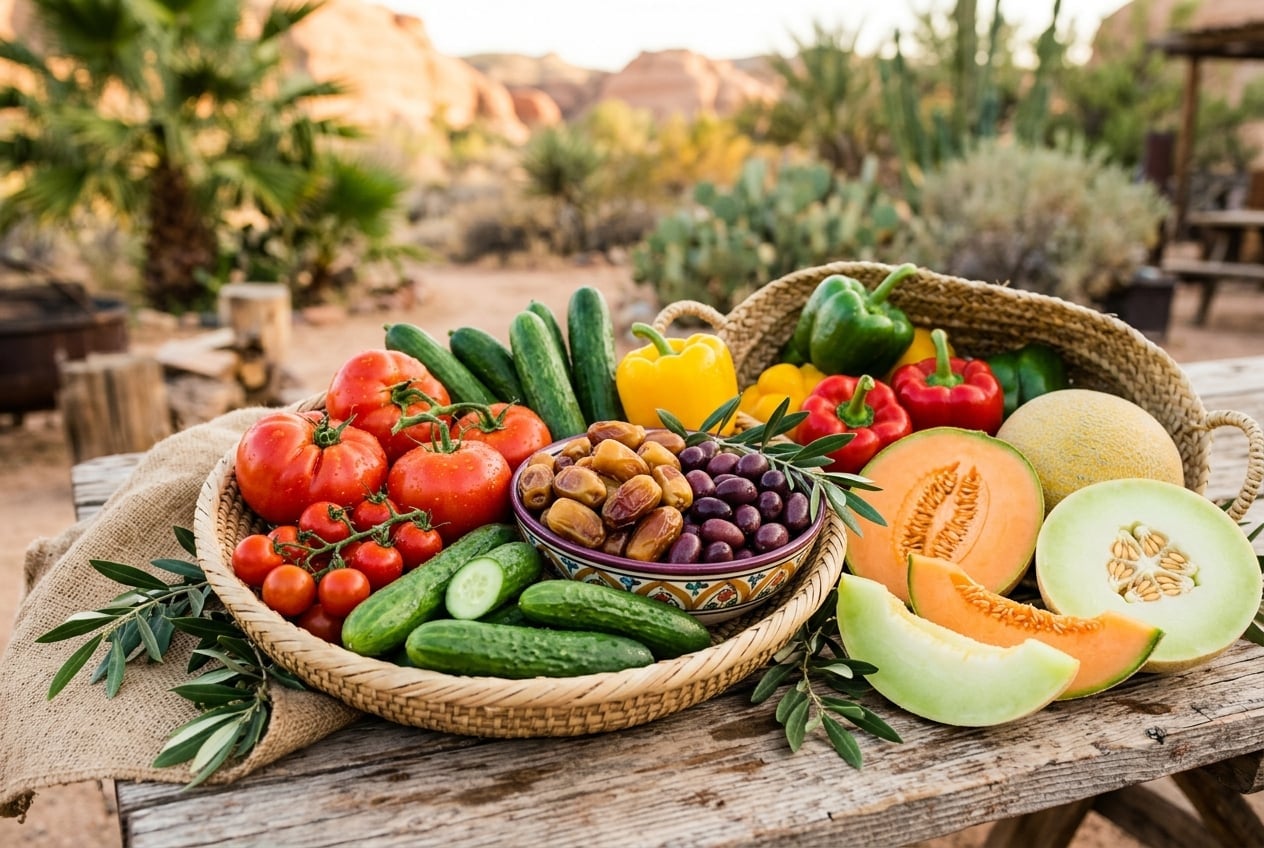
Dates
The quintessential Saharan fruit. Date palms have been cultivated for millennia in oases, producing 8–10 tons per hectare with minimal water.
Olives
Highly drought-resistant and perfectly suited to the Mediterranean-Saharan transition zone. Produces premium oil and table olives.
Watermelon
Thrives in hot, arid conditions with deep root systems that access subsurface moisture. A refreshing and commercially valuable desert crop.
Cantaloupe
Melons are naturally adapted to desert heat. They produce sweet, aromatic fruit with relatively low water requirements.
Figs
An ancient fruit tree that thrives in hot climates. Drought-tolerant once established, producing two harvests per year.
Pomegranates
Exceptionally heat-tolerant and drought-resistant. High-value superfruit increasingly cultivated in North African desert regions.
The Desert Can Feed Millions
With the Nubian Sandstone Aquifer holding enough water to irrigate the entire Sahara for centuries, strategic drilling and modern irrigation could transform North Africa into a major agricultural hub — feeding hundreds of millions while creating sustainable livelihoods across the region.
What Lies Underground
The Sahara is far more than sand — beneath its surface lies a treasure trove of minerals, fossil fuels, ancient civilizations, and prehistoric creatures.
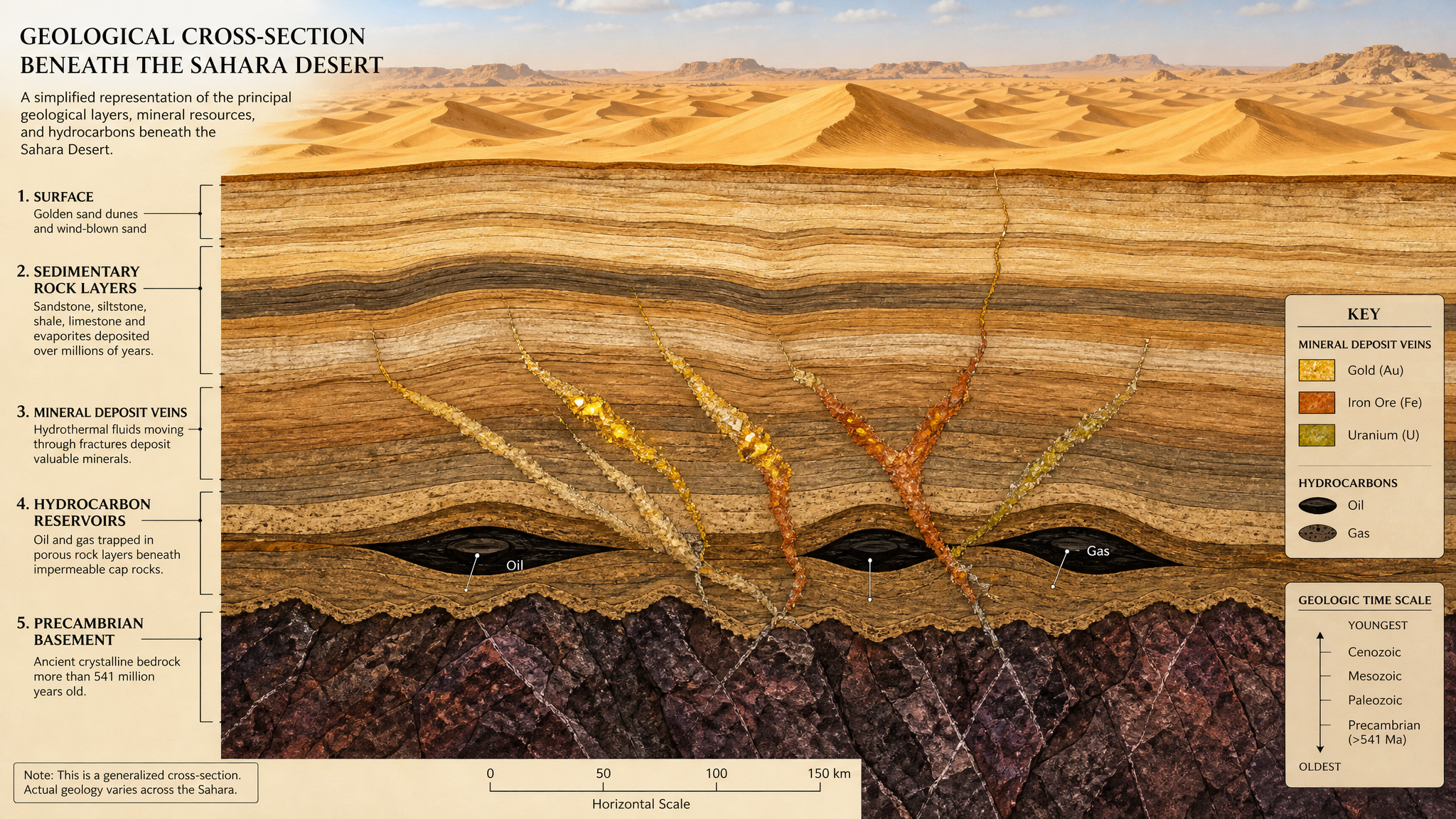
Cross-section of the Sahara — from surface dunes to billion-year-old bedrock
Geological Layers
Surface Sand & Ergs
0–50mOnly 20% of the Sahara is sand dunes. The rest is rocky plateaus (regs), barren hammadas, and dry riverbeds (wadis).
Sedimentary Basins
50–500mThick layers of sandstone, limestone, and shale formed over millions of years — reservoirs for water, oil, and gas.
Mineral-Rich Veins
200–1,500mGold, iron ore, uranium, phosphate, copper, and rare earth elements locked within geological formations.
Precambrian Bedrock
1,000m+Ancient crystalline shields billions of years old — the stable foundation of the African continent.
Minerals & Resources
The Sahara sits atop one of the richest mineral belts on Earth. From phosphate that feeds global agriculture to rare earth elements powering our technology — the desert\'s underground wealth is staggering.
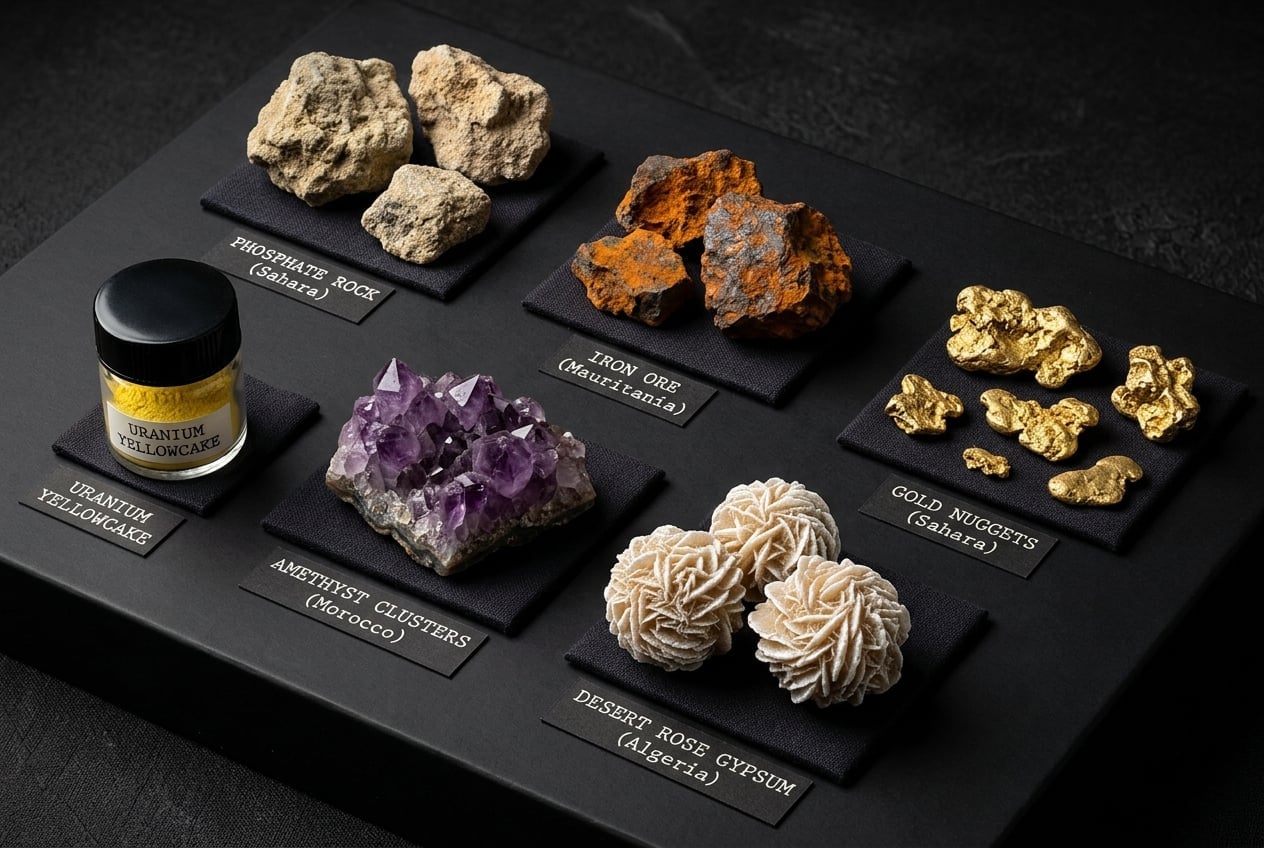
Phosphate
Morocco & Western SaharaMorocco and Western Sahara hold ~70% of global phosphate reserves. The Bou Craa mine alone contains 9% of world supply — vital for agricultural fertilizers.
Iron Ore
Western Sahara & MauritaniaHigh-grade iron ore (38–65% iron content) suitable for direct steelmaking. Mauritania's Mount Ijill is a major extraction site.
Gold
Oued Eddahab & Mali borderGold-bearing formations identified across several regions. Artisanal mining and modern exploration coexist in the southern Sahara.
Uranium
Niger & AlgeriaNiger's Arlit mines are among Africa's largest uranium producers, supplying fuel for nuclear energy worldwide.
Rare Earth Elements
Western Sahara (Tiris)Critical for renewable energy tech, electronics, aerospace, and military applications. A strategic resource for the future.
Copper & Manganese
Mauritania & AlgeriaEssential industrial metals found in the Adrar Soutaf and Saguia el-Hamra regions. Key for construction and electronics.
Precious & Semi-Precious Stones
Fossil Fuels
The Sahara\'s subsurface holds enormous hydrocarbon reserves that drive entire national economies.
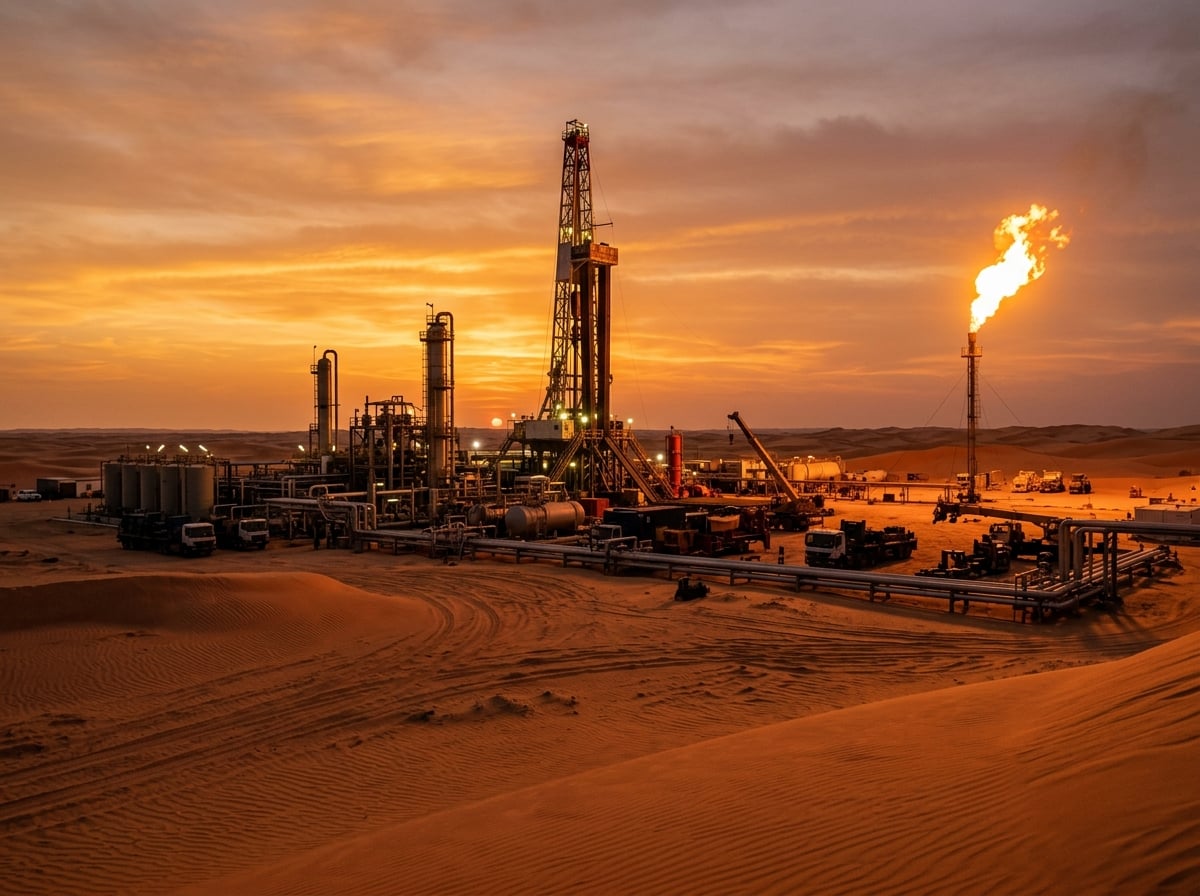
Oil Reserves
Algeria and Libya are among Africa's top oil producers. Algeria's hydrocarbons account for ~60% of national income. Vast reserves remain in the Hassi Messaoud and Sirte Basin fields.
Natural Gas
Algeria holds the 10th largest proven natural gas reserves globally. The Hassi R'Mel field is one of the world's largest gas deposits, feeding pipelines to Europe.
Oil Shale
Untapped oil shale deposits have been identified across multiple Saharan basins, representing potential future energy sources as extraction technology evolves.
Ancient Discoveries
Dinosaurs, lost civilizations, and prehistoric art — the Sahara is an archaeological time capsule.
Spinosaurus & Dinosaurs
95–70 million years agoThe Sahara has yielded some of the most spectacular dinosaur discoveries, including Spinosaurus — the largest known predatory dinosaur — and Mansourasaurus from Egypt.
Nabta Playa Observatory
7,000+ years oldA megalithic stone circle in Egypt's Western Desert, predating Stonehenge by 1,000 years. Used to track solstices and predict monsoon seasons.
Gobero Cemetery
7,500–2,500 BCEThe largest Stone Age burial ground in the Sahara (Niger). 182+ burials of two distinct cultures — the Kiffian fisher-foragers and Tenerian herders.
Garamantes Civilization
2,000+ years agoAn advanced urban civilization in Libya that built underground irrigation tunnels (foggaras) to tap fossil aquifers, sustaining complex towns in the desert.
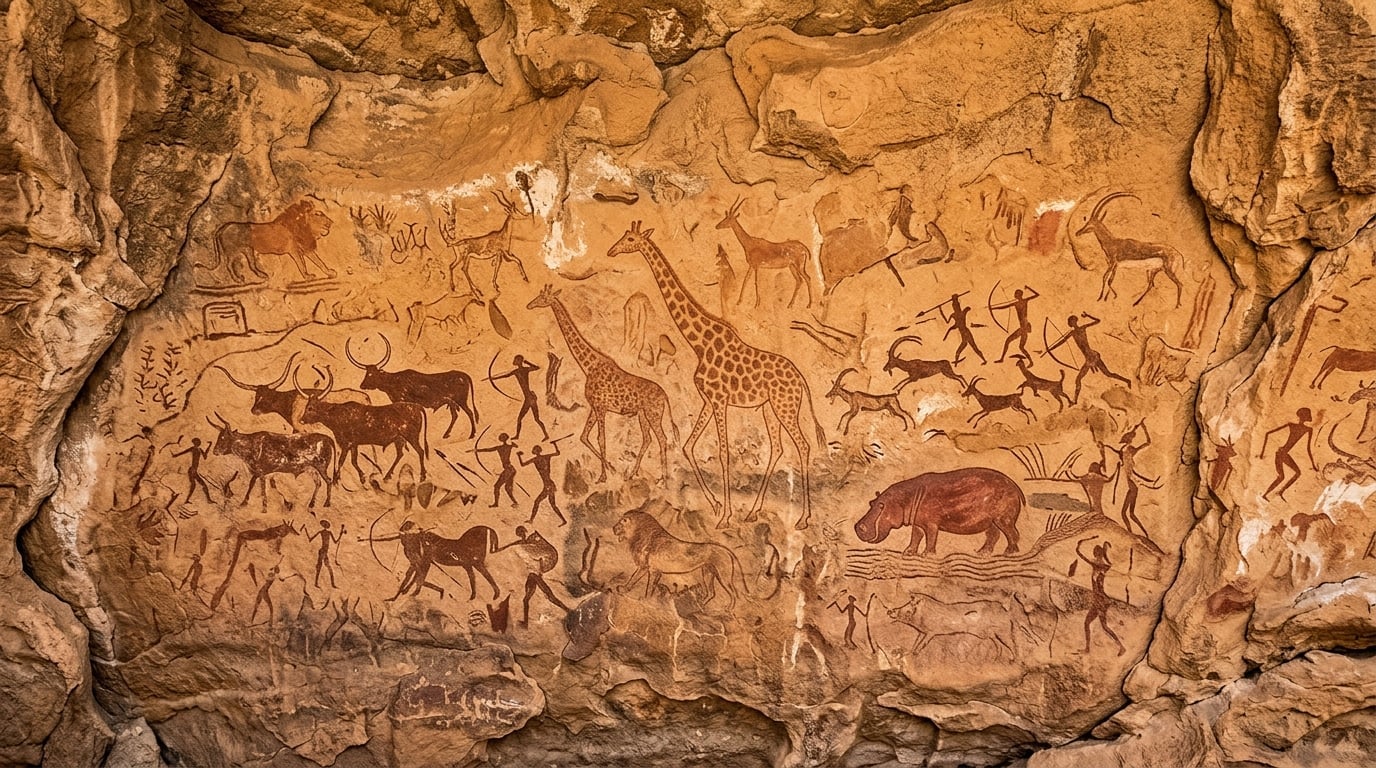
Tassili n'Ajjer Rock Art
12,000–2,000 years agoOver 15,000 rock engravings and paintings in Algeria documenting the Sahara's transformation from lush savanna to desert — a UNESCO World Heritage Site.
Super-Croc (Sarcosuchus)
112 million years agoA 12-meter prehistoric crocodilian discovered in Niger — one of the largest crocodile-like creatures to ever live, evidence of the Sahara's ancient waterways.
“The Sahara is not empty — it is a vault. Beneath every grain of sand lies a chapter of Earth's history, a resource for the future, and a mystery waiting to be uncovered.”
Purifying the Nile
From ancient alum coagulation 3,500 years ago to AI-powered treatment plants today — the story of humanity's oldest water purification challenge.
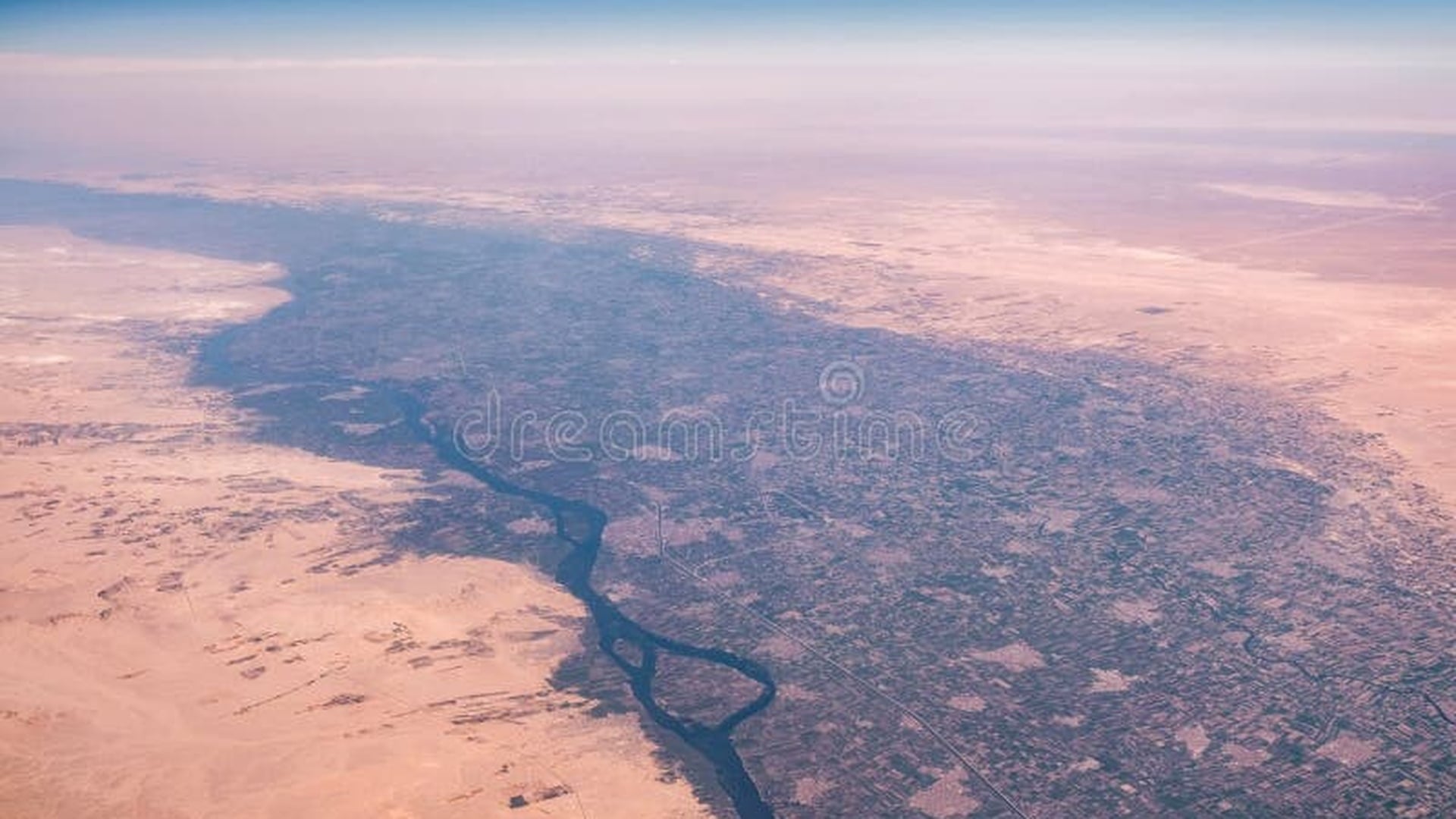
The Nile — lifeline of North Africa, supplying 97% of Egypt's freshwater
The Pollution Challenge
The Nile receives ~4.5 million tons of contaminants annually from 124 identified sources between Aswan and el-Kanater.
Industrial Waste
57 discharge pointsHeavy metals (cadmium, lead, chromium), oils, chemical oxygen demand (COD)
Agricultural Runoff
67 drainage pointsPesticides, fertilizers (nitrogen, phosphorus), causing eutrophication and dead zones
Municipal Sewage
4.5M tons/yearPathogens, organic pollutants, microplastics, pharmaceutical residues
Ancient Egyptian Methods
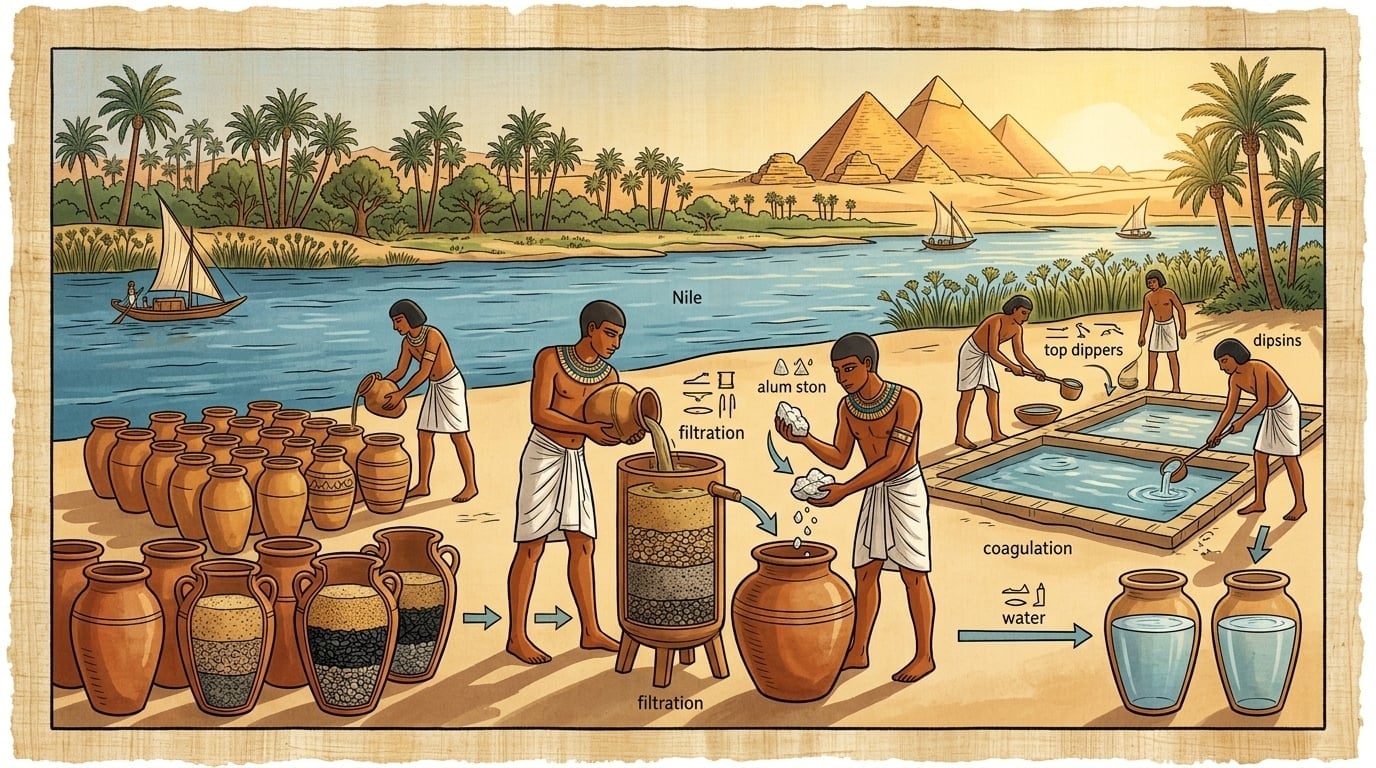
Ancient Egyptians were pioneers of water purification, developing techniques 3,500 years ago that form the foundation of modern treatment. They mastered chemical coagulation, physical filtration, and thermal treatment millennia before germ theory was discovered.
Alum Coagulation
1,500 BCEAncient Egyptians pioneered chemical water treatment using alum (aluminum sulfate) to cause suspended impurities to clump together and settle — a technique still used in modern plants today.
Sand & Gravel Filtration
3,000+ years agoLayered filterbeds of coarse gravel at the bottom and fine sand on top allowed water to percolate through, physically trapping contaminants. Depicted in ancient tomb paintings.
Ceramic Vessel Storage
Predynastic eraPorous clay vessels served as natural microfiltration systems. Water seeping through the clay walls left impurities behind while keeping the water cool.
Boiling & Thermal Treatment
Ancient practiceEgyptians recognized that heating water killed invisible contaminants. Boiling was a standard practice for water intended for drinking and medical use.
Siphon Technology
Reign of Amenhotep IISiphons were used to transfer clear water from the top of settling vessels, separating it from sediment that had sunk to the bottom.
Nilometers
3,000+ years agoInstruments that monitored Nile flood levels, helping predict water quality changes. High floods brought nutrient-rich silt; low floods concentrated pollutants.
Modern Purification Process
From river to tap — the six-stage journey that transforms Nile water into safe drinking water.
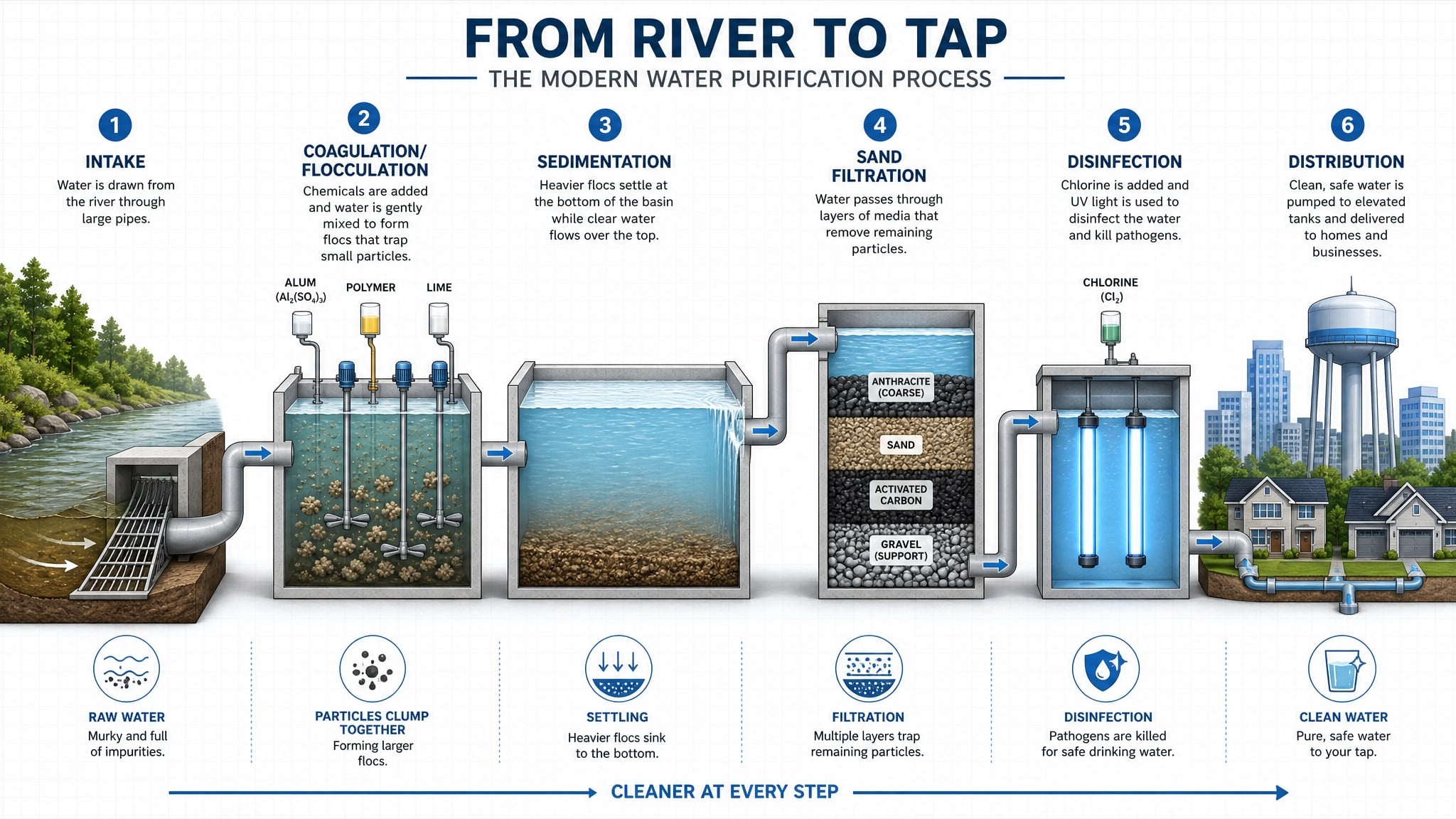
Water Intake
Raw water is drawn from the Nile through large intake pipes and screens that remove debris, branches, and large particles.
Coagulation & Flocculation
Chemicals like alum (aluminum sulfate) are added to neutralize charges, causing tiny particles to clump together into larger "flocs" that can be removed.
Sedimentation
Water flows slowly through large basins where heavy flocs settle to the bottom by gravity. This removes up to 90% of suspended solids.
Sand Filtration
Water passes through layered beds of sand, gravel, and activated carbon. Fine particles, bacteria, and organic matter are trapped in the filter media.
Disinfection
Chlorine or UV light destroys remaining pathogens (bacteria, viruses, parasites). This ensures water is biologically safe for human consumption.
Distribution
Purified water is stored in reservoirs and distributed through pipe networks to homes, businesses, and agricultural systems across the region.
Advanced Technologies
Cutting-edge filtration, membrane systems, and smart monitoring are revolutionizing Nile water treatment.
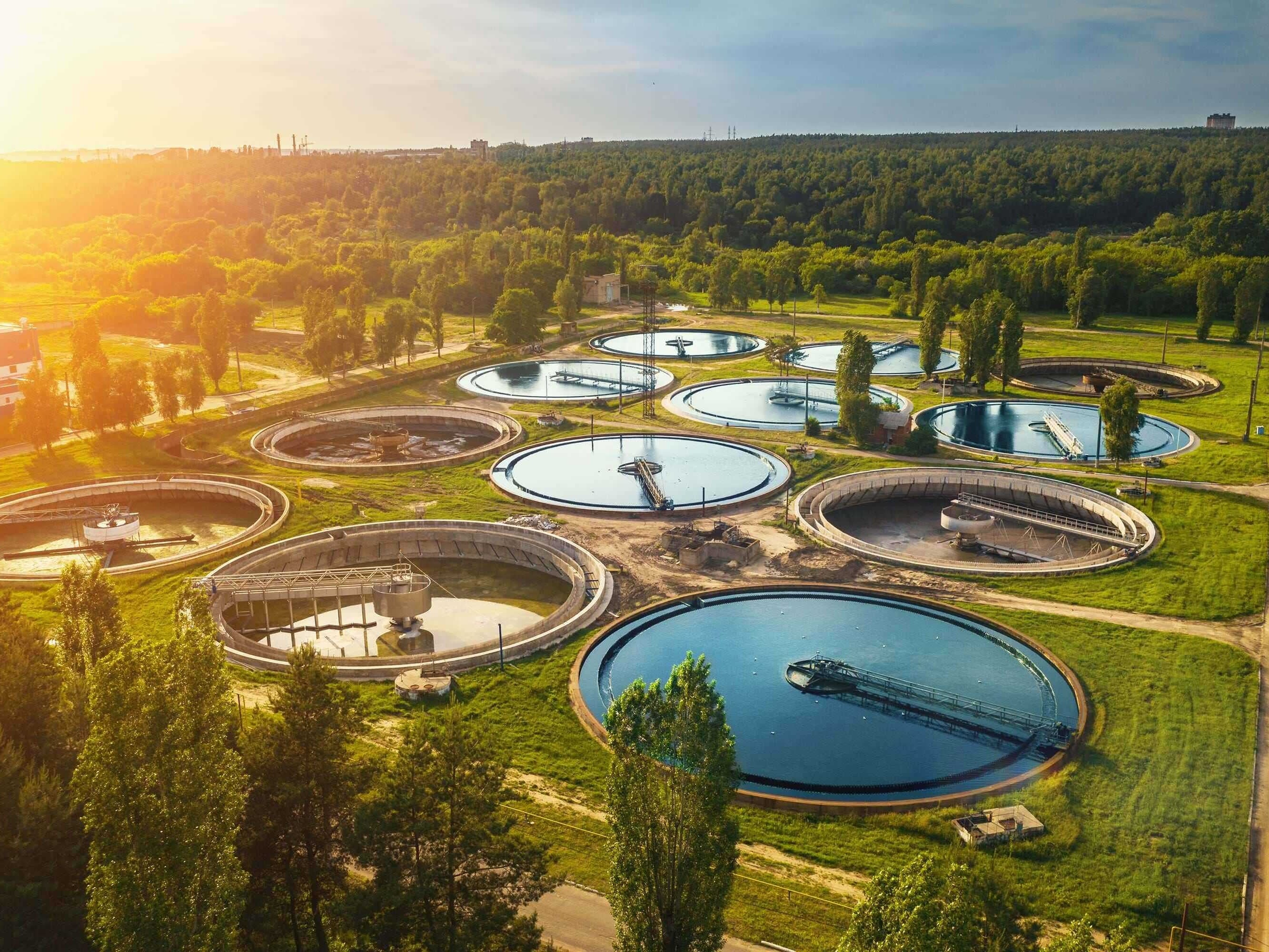
Reverse Osmosis (RO)
95-99%Forces water through semi-permeable membranes at high pressure, removing 95-99% of dissolved salts, heavy metals, and organic contaminants. Used for desalination and groundwater treatment.
Nanofiltration (NF)
90-95%Membrane technology that targets specific contaminants while retaining beneficial minerals. Lower energy consumption than RO, ideal for softening and micropollutant removal.
Ultrafiltration (UF)
85-95%Removes bacteria, viruses, and suspended solids using hollow fiber membranes. Frequently used as pretreatment before RO or as primary treatment for surface water.
Riverbank Filtration (RBF)
80-90%Natural purification where water is drawn through soil along riverbanks. Physical, chemical, and biological mechanisms remove contaminants — 160+ projects active in Egypt.
UV Sterilization
99.9%Ultraviolet light destroys the DNA of microorganisms, preventing reproduction. Chemical-free disinfection that leaves no residual taste or byproducts.
AI & IoT Monitoring
Real-timeSmart sensors and artificial intelligence provide real-time water quality monitoring, automated alerts, and predictive maintenance for treatment facilities.
Mega Projects
Bahr al-Baqar Treatment Plant
Port Said, Egypt
One of the world's largest wastewater treatment facilities. Processes agricultural and industrial wastewater to produce irrigation-grade water for the Sinai Peninsula.
National Canal Lining Project
Nationwide, Egypt
Concrete lining of Egypt's irrigation canal network to reduce water seepage and loss, improving delivery efficiency across the agricultural sector.
Nile River Revival Action Plan
Basin-wide
International initiative to upgrade treatment plants, train personnel, improve monitoring, and implement natural purification methods across the Nile Basin.
Ancient Wisdom, Modern Solutions
The challenge of purifying the Nile has spanned millennia. Today, combining Egypt's ancient knowledge of coagulation and filtration with cutting-edge membrane technology, AI monitoring, and massive infrastructure investment offers a path to securing clean water for the 257 million people who depend on this extraordinary river.
Treasures of the Sahara
Beyond water and fossils of the sea, the desert sands have preserved treasures that revolutionize our understanding of Earth and human history.
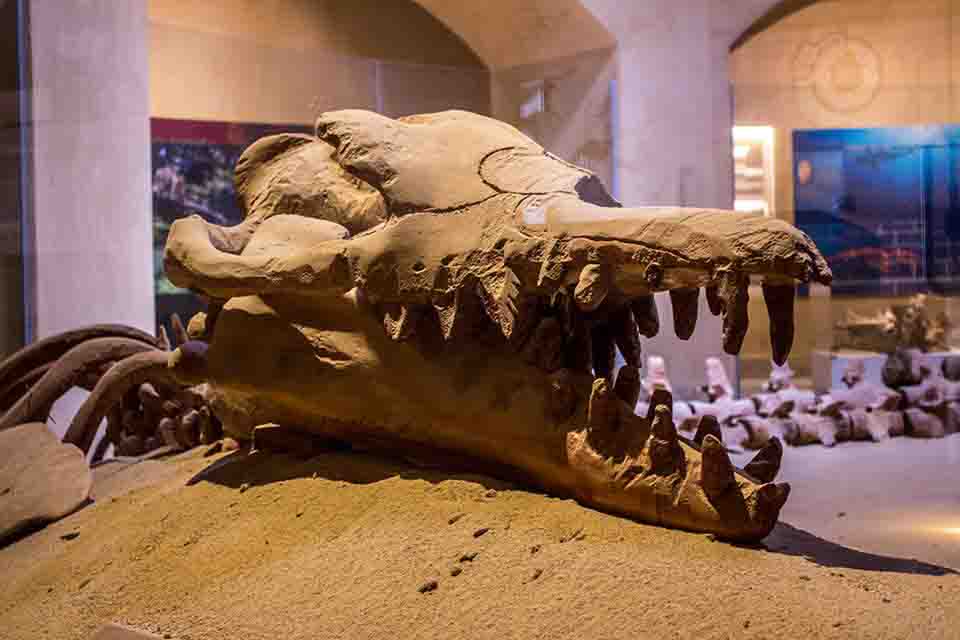
Ancient Whale Fossils
Wadi Al-Hitan preserves hundreds of whale skeletons from 40 million years ago, including species that bridge the gap between land and sea mammals.
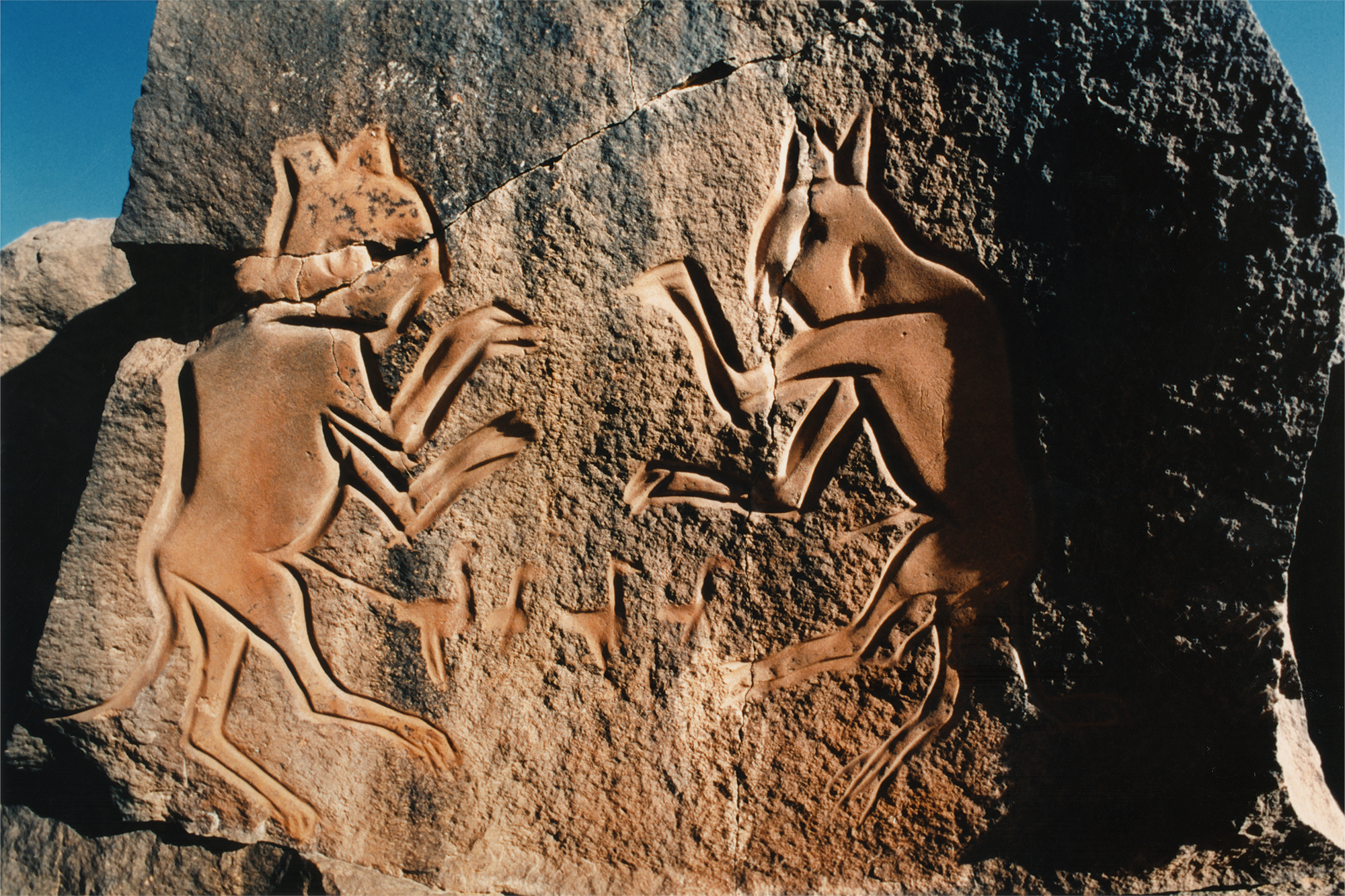
Rock Art & Cave Paintings
Thousands of ancient rock engravings depict giraffes, elephants, cattle, and people swimming — vivid scenes from when the Sahara was a vibrant savanna.
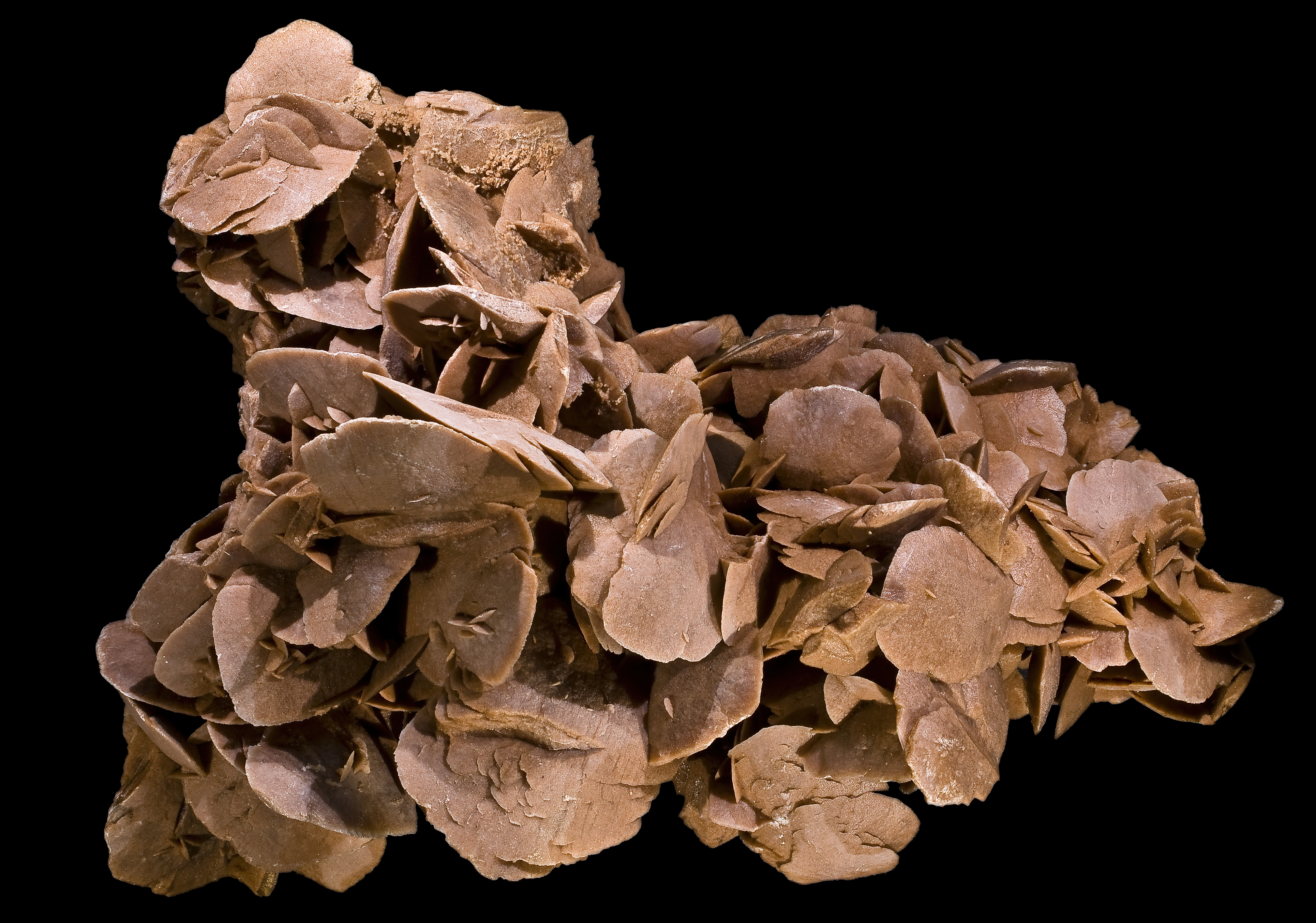
Desert Rose Crystals
These spectacular mineral formations of gypsum and sand are unique to desert environments, forming beautiful rosette-shaped crystal clusters.

Human Origins
At Jebel Irhoud, Morocco, Homo sapiens fossils dating back 300,000 years were discovered, pushing back the known timeline of our entire species.
From Green to Gold and Back Again
The Sahara is not a static wasteland — it's a dynamic landscape that has oscillated dramatically between lush savanna and arid desert.
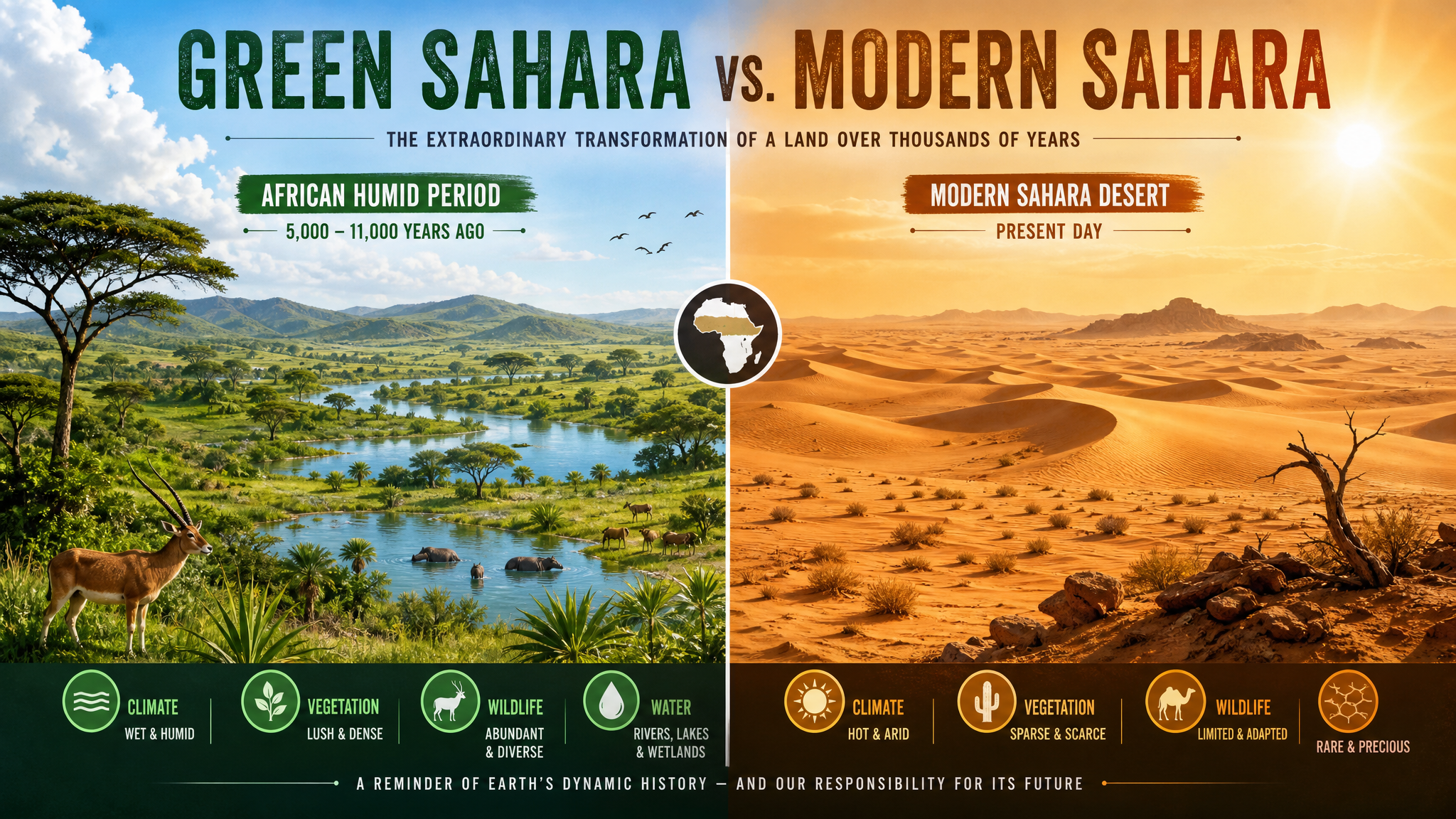
The “Green Sahara” — a recurring transformation driven by Earth's orbital cycles
Green Sahara Period
11,000 – 5,000 years ago
The last "African Humid Period" turned the Sahara into a lush savanna with lakes, rivers, and grasslands. Humans, hippos, and crocodiles thrived across the region.
Rapid Desertification
~5,000 years ago
The Sahara dried out rapidly, possibly within centuries. Human populations migrated to the Nile Valley, contributing to the rise of ancient Egyptian civilization.
20,000-Year Cycle
Ongoing
Driven by Earth's axial precession, the African monsoon shifts cyclically. Scientists continue studying whether the Sahara could green again in the future.
“The Sahara is not timeless. It is a powerful reminder of our planet's capacity for dramatic change.”
From a prehistoric ocean teeming with whales to the vast hidden reservoir beneath its dunes, the Sahara holds one of Earth's most profound geological stories.